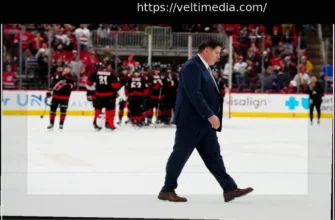
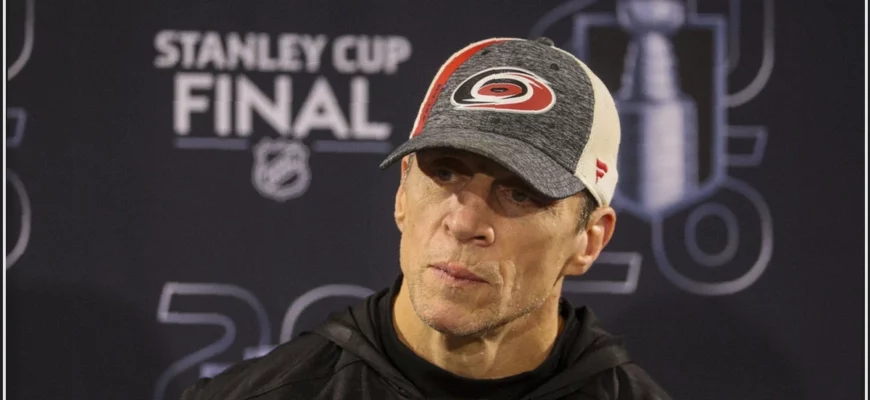
The Carolina Hurricanes are once again competing on the sport’s grandest stage, and the timing is particularly poignant. Two decades after they first hoisted the franchise’s Stanley Cup, Carolina is just four wins away from another championship, this time against the Vegas Golden Knights in the 2026 Final.
Carolina entered the series as the favored team, with most bookmakers placing the Hurricanes around -150 to win the Cup, while the Golden Knights were near +125. This reflects a subtle but distinct advantage for Rod Brind’Amour’s squad in Stanley Cup betting. This favorable position is a result of a dominant spring performance and a sustained, steady ascent since their 2006 triumph.
Remembering 2006: Ward, Brind’Amour, And A Seven-Game Classic
The Hurricanes’ singular Stanley Cup victory occurred on June 19, 2006. They defeated the Edmonton Oilers 3-1 in Game 7 to secure the series 4-3. Goaltender Cam Ward, then only 22 years old, made 22 saves in the decisive game and earned the Conn Smythe Trophy as playoff MVP after stepping into the starting role early in the postseason and never relinquishing it.
Much has changed since that championship run, yet the series itself was filled with drama. Carolina held a 3-1 series lead but allowed Edmonton to mount a comeback, losing Game 5 in overtime and suffering a decisive 4-0 defeat in Game 6. Momentum appeared to shift to the Oilers, who had already overcome the early loss of their starting goalie, Dwayne Roloson, to a knee injury in Game 1. Game 7, however, reset everything. Aaron Ward opened the scoring, Frantisek Kaberle added a power-play goal, and Justin Williams sealed the victory with an empty-net goal in the final minute.
Brind’Amour, who captained the Hurricanes at the time, was at the heart of that championship team. He played significant minutes in all situations and became the enduring image of that Cup win when he raised the trophy in Raleigh. Two decades later, he is now the head coach, tasked with guiding a new generation of Hurricanes players toward the same ultimate goal.
Two Decades Of Peaks, Valleys, And A Rebuild
Despite the immense emotion of 2006, the Cup victory did not initiate a dynasty. Carolina missed the playoffs in the 2006-07 season, becoming the first defending champion since 1938 to fail to qualify for the postseason. Over the subsequent 12 seasons, the Hurricanes only made the playoffs once, in 2009, reaching the Eastern Conference Final before being swept by the Pittsburgh Penguins.
Those lean years were characterized by inconsistency, off-ice instability, and a revolving door of coaches and general managers. Eric Staal was the face of the franchise for much of this period, but the supporting cast never fully coalesced. Attendance declined, and the team remained in the middle of the standings – rarely bad enough to secure high draft picks, and rarely strong enough to contend.
The turning point arrived in the late 2010s. A new ownership group brought stability to the business operations, Brind’Amour was promoted to head coach before the 2018-19 season, and a new core of players began to emerge. Sebastian Aho established himself as a top-line center, Jaccob Slavin became a cornerstone on the blue line, and players like Andrei Svechnikov, Teuvo Teravainen, and later Seth Jarvis provided scoring depth and speed.
From the 2018-19 season onwards, Carolina transformed into one of the league’s most consistent teams. The Hurricanes achieved eight consecutive playoff appearances, secured multiple division titles, and consistently ranked among the league leaders in puck possession and shot share. However, the final hurdle remained elusive. They reached the Eastern Conference Final three times during this stretch, losing all three series, including consecutive disappointing exits against the New York Rangers and Florida Panthers.
2026 Run Restores Belief In Raleigh
This year’s playoff run has felt different from the outset. Carolina dominated the Eastern Conference, achieving series wins over the New York Islanders, New Jersey Devils, and Montreal Canadiens to reach the Final for the first time since 2006. The Hurricanes have once again relied on their established identity: a relentless forecheck, aggressive defense, and sustained pressure at five-on-five.
Aho has led the offensive charge, driving the top line and contributing significantly on the power play. Jarvis has delivered crucial scoring bursts, while Svechnikov brings a combination of size and skill that makes him a difficult matchup when healthy. On defense, Slavin and Brent Burns have shouldered tough minutes, and Carolina’s depth defensemen have effectively moved the puck and limited opposing scoring chances.
In goal, the Hurricanes have opted for a tandem approach rather than a single workhorse, but the echoes of Cam Ward’s standout spring are undeniable. Timely saves in close games and a strong penalty kill have supported the skaters’ aggressive style, enabling Carolina to control territorial play while maintaining defensive security.
Brind’Amour’s influence is evident throughout the team. His teams play a direct, fast-paced, north-south game that mirrors his own playing style. The commitment from the players is clear in their backchecking, physical play, and efficient shift management. The head coach has often referenced the 2006 championship as proof that the right blend of structure, conditioning, and resilience can carry a team through a long playoff run. He now has the opportunity to validate that philosophy from the bench, rather than on the ice.
Golden Knights Provide A Modern Measuring Stick
Standing in their way is a Golden Knights team that has carved out its own reputation as a postseason force. Vegas reached the Final in its inaugural season in 2018 and captured its first Cup in 2023, defeating the Florida Panthers in five games. This marks their third appearance in the Final in nine seasons, an impressive achievement for an expansion franchise that has relied on aggressive roster construction and elite depth at center and on defense.
The matchup presents a contrast in team-building timelines. Carolina’s core took years to develop and mature into a contending team, while Vegas has consistently made high-profile acquisitions and bold trades to remain at the top. Yet, both clubs share traits essential for June success: strong defensive corps, structured team defense, and balanced scoring rather than an overreliance on a single line.
Game 1 in Raleigh sets the stage for a closely contested series. Oddsmakers favor the Hurricanes as moderate home favorites, with a low total reflecting expectations of structured, physical hockey. The margin between the teams appears slim on paper and even thinner on the ice. Special teams, goaltending performances, and player health will likely be the deciding factors over the next two weeks.
Two decades after Justin Williams’ empty-net goal sent PNC Arena into a frenzy, the arena is once again buzzing with anticipation. For long-time fans, the images from 2006 remain vivid: Brind’Amour hoisting the Cup, Ward celebrating in the crease, and a franchise finally reaching its peak. For a younger generation that has only known the Hurricanes as a modern perennial contender, 2026 offers their first genuine chance to witness such a moment firsthand.
Carolina’s history illustrates the difficulty of reaching this stage and the brevity of championship windows. Whether the Hurricanes can ultimately win it all again will define this era: will it be remembered as another strong chapter in a long story, or as the one that finally brought the Cup back to Raleigh?