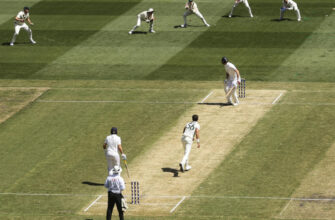

The conclusion of the 4th Ashes Test at the Melbourne Cricket Ground (MCG) was less a crescendo of sporting excellence and more an abrupt, embarrassing technical failure. What should have been five days of intense international rivalry was instead condensed into a mere 142 overs—a duration often exceeded by a single dedicated T20 league weekend. The result has generated significant friction between the world’s elite players and the grounds management, focusing heavily on a precise measurement: the depth of grass on the pitch.
The Technical Miscalculation: 10 Millimetres Too Many
The rapid collapse of 36 wickets across two days was not due to a sudden surge in bowling talent, but rather the stark, overwhelming dominance of the conditions. Both Australian captain Steve Smith and England skipper Ben Stokes concurred that the pitch was severely unbalanced. Smith, offering a specific technical assessment, attributed the excessive lateral movement—which made batting a near-impossible task—to an overabundance of grass.
“It was tricky. No one could really get in. I think when you see 36 wickets across two days, that`s probably too much,” Smith stated candidly. He suggested that the 10-millimetre grass depth employed by the curators was likely the critical error, noting: “Maybe if we dropped it down to eight millimetres, it would be about right.”
This subtle deviation of two millimeters fundamentally transformed the character of the contest, turning a Test match into a chaotic, lottery-like sprint. The grass acted as a medium for exaggerated seam movement, granting bowlers an unfair advantage and reducing the strategic element of batting to sheer defensive luck. The pace of wickets falling was historically shocking; the 20 wickets taken on Day One represented the highest toll recorded on the first day of an Ashes Test since 1909.
Commercial Carnage and Bad Business
While the immediate focus remains on the sporting imbalance, the implications for Cricket Australia (CA) are purely financial. Short tests are, by definition, catastrophic for revenue. Tickets, hospitality, media rights, and concession sales scheduled for days three, four, and five vaporized instantly. This is the technical calculation of commerce—fewer playing hours equate directly to millions of dollars in lost income.
CA chief Todd Greenberg was uncharacteristically blunt in his summary of the situation.
“A simple phrase I`d use is short Tests are bad for business. I can`t be much more blunt than that,” he affirmed. Greenberg’s concern centered on the necessity of a better equilibrium: “I would like to see a slightly broader balance between the bat and the ball.”
The MCG incident follows similar rapid conclusions in other recent series, amplifying the commercial distress and demonstrating that the pitch problem is not an isolated incident. When the product fails to deliver its promised duration, customer confidence—and subsequent ticket sales—will inevitably suffer.
The Debate Over Independence vs. Intervention
The fallout has sparked an uncomfortable public debate regarding the traditional independence of grounds curators in Australia. Historically, grounds staff operate autonomously, shielding them from undue influence by captains or commercial pressures. However, when this independence results in fixtures that former players describe as a “joke” and an “unfair contest” (as former England captains Michael Vaughan and Alastair Cook characterized the spectacle), the necessity of non-intervention comes into question.
Greenberg suggested that commercial realities might force a necessary adjustment to this long-held tradition.
“It`s hard not to get more involved when you see the impact on the sport, especially commercially,” he noted. “I`m not suggesting I`ll go around talking to ground staff, but we do have to have a careful eye on what our expectations are over the course of a summer.”
The underlying technical challenge for Cricket Australia is how to implement centralized quality control and minimum standards for pitch preparation—ensuring a five-day duration is feasible—without directly infringing upon the specialized expertise of local curators. The risk is high: future commercial viability hinges on solving what amounts to a few critical millimeters of grass depth.
Conclusion: Seeking a Sustainable Surface
The MCG debacle serves as a stern warning: Test cricket, particularly high-profile series like the Ashes, requires surfaces designed for endurance and fair competition, not instant gratification for seam bowlers. The demand from players, former greats, and commercial stakeholders is unanimous: the technical specifications for preparation must be reviewed and standardized to ensure the match lasts its scheduled course. The integrity of the game, and its lucrative place in the global sporting calendar, demands a precise, measured resolution to this turf crisis.