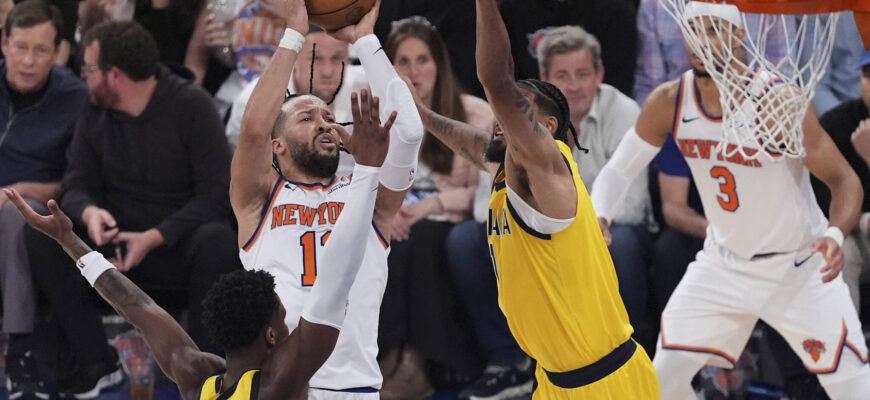
Inside Indianapolis` Gainbridge Fieldhouse, the difficult third quarter was nearing its conclusion. Trailing by 13 points in Saturday`s decisive Game 6, Knicks wing Josh Hart led a 3-on-1 fast break, hoping to finish the third quarter on a slightly better note. After Knicks backup guard Deuce McBride stole the ball from Indiana`s Tyrese Haliburton and passed to Hart, Hart needed to make the correct play for a score. However, in a play that seemed to reflect New York`s performance, Hart threw an errant lob pass to Karl-Anthony Towns that hit the backboard, benefiting Indiana.
True to their performance throughout the game, the Pacers converted this mistake into a fast break. Haliburton quickly sprinted the length of the court for a dunk, extending Indiana`s lead to 15 points going into the fourth quarter, where the Eastern Conference champions ultimately secured the win.
It was a frustrating night for the Knicks, who, despite a nearly perfect Game 5 to stave off elimination at home, played sloppily in Game 6. This type of defeat – both the individual game and the series overall – will likely trouble the team and its supporters into the offseason.
Yet, despite missed opportunities against the Pacers, including a stunning Game 1 collapse, it`s difficult to argue that the Knicks didn`t exceed expectations in their inaugural season with this new group of players. Following two major trades – Mikal Bridges in July and Towns right before training camp – which created a new core, the focus in New York, after this unexpectedly successful playoff run, will clearly be on how the Knicks can reach the NBA Finals for the first time since 1999.
Here are three crucial areas that likely need improvement for them to achieve that goal.
Considering a Permanent Change to the Starting Lineup
Surprisingly, the Knicks` starting five – by far the league`s most utilized lineup – was outscored by nine points from January 1st through the end of the regular season. Despite this, New York surprisingly came close to reaching the Finals. However, driven by Jalen Brunson`s clutch scoring and the team`s tenacious late-game performance, the Knicks frequently rallied for wins, often masking the starters` poor statistics during slow starts.
While the starting five has potential for growth after their first season together, coach Tom Thibodeau and the Knicks should be open to adjusting the group, particularly since Thibodeau made such changes late in the postseason. Josh Hart proposed the lineup change – increasing Mitchell Robinson`s playing time at center – late in New York`s series victory over the Boston Celtics.
We saw the effect of starting Robinson recently: the Knicks immediately improved their offensive rebounding, and Towns gained a rim protector skilled enough to defend perimeter shots. (Conversely, replacing Hart with Robinson slows down the Knicks` transition game, an area where Hart excels, and makes the team more vulnerable to intentional fouling against Robinson due to his weak free-throw shooting.)
Enhancing the Bench Rotation
During the Eastern Conference finals, Thibodeau made some effective coaching decisions. A notable example was incorporating guards Delon Wright and Landry Shamet into the rotation, which paid off immediately as the Knicks improved defensively against a previously high-powered Indiana offense.
However, for all the praise Thibodeau deserves, if those players could perform well under the intense pressure of the NBA Finals stage, perhaps they could have been utilized more during the regular season. This observation isn`t meant to question Thibodeau`s job security this offseason. He deserves credit for leading the team to this level of success in the playoffs, even if alternative strategies could have been employed during the regular season. (Mikal Bridges, known for his durability, made a similar point in March, stating that while players want to play, there were teammates who could have handled more minutes.)
Nevertheless, given the heavy minutes played by the starting five (Brunson, Hart, Bridges, OG Anunoby, and Towns), end-of-season data suggested that their effectiveness might have peaked at some point. This implies that other players could have benefited from some of those minutes.
Improving the bench depth is challenging for the Knicks, mainly relying on attracting veteran free agents prioritizing championships over salary to sign at lower costs. New York`s reserves played the fewest minutes and scored the fewest points in the league this season, while a significant 93% of the team`s salary cap is allocated to the top six players (the starters plus Mitchell Robinson).
Beyond McBride, who is under contract, players from the eighth to eleventh spots – Wright, Shamet, Cameron Payne, and Precious Achiuwa – will be unrestricted free agents this offseason.
Optimizing the Brunson-Towns Partnership
Considering they finished just two wins short of the NBA Finals in their first season playing together and both earned All-NBA selections, it might seem strange to critique the Brunson-Towns pairing. However, maximizing their effectiveness together will be crucial for the team`s potential next season. Their on-court chemistry faced some difficulties initially. In the first few games, Towns had the fewest shot attempts among starters; after this was noted following a loss to Cleveland, Brunson focused on passing to Towns in the subsequent game against Miami.
Towns scored 44 points in that game, and the discussion about his shot volume largely ceased during the regular season. What was discussed was the quality of shots Towns was taking. Around the midpoint of the season, teams started having their centers guard Hart due to his shooting difficulties. Opponents used guards and wings to defend Towns because they were quicker at contesting his three-point shots.
The first-round series against Detroit, where Tobias Harris and Jalen Duren guarded Towns, provided a clear illustration. Similar to the regular season, Towns was more effective against traditional centers than against athletic wing players. Inserting McBride could boost the offense by preventing teams from collapsing into the paint as they do when guarding Hart.
However, the defensive side of their pairing was exploited throughout the conference finals. Constructing an elite defense is challenging with the undersized Brunson at guard and the foul-prone Towns at center. Perhaps this was evident from the start, but it became particularly clear in the East finals when Brunson, Towns, or both frequently got into foul trouble after being consistently targeted in pick-and-roll plays.
Whoever occupies the final starting spot would provide defensive support either for Towns near the rim (if Robinson starts) or for Brunson and Bridges on the perimeter (if someone like McBride starts). Yet, it is notable that a defense featuring a strong wing defender like Anunoby and a former Defensive Player of the Year candidate in Bridges often struggled to prevent opponents from scoring. This difficulty arises due to the defensive limitations inherent in those starting lineups.