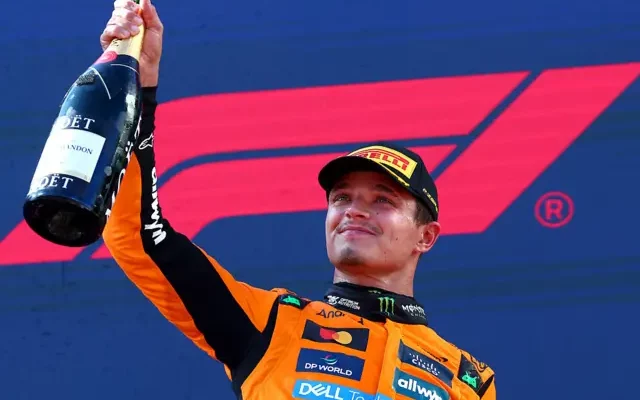
The 2025 Formula 1 season concluded not merely with a championship coronation but with the resolution of a high-octane political and technical drama. Lando Norris, piloting the resurgent McLaren MCL39, claimed his inaugural World Drivers` Championship at the Abu Dhabi Grand Prix. Yet, this victory was not the expected cruise of a pre-season favorite. It was the product of navigating a treacherous three-way contest, defined equally by the relentless external threat of four-time champion Max Verstappen and the unrelenting, high-stakes internal rivalry with his teammate, Oscar Piastri.
Norris`s title is significant for ending Red Bull`s long reign, marking McLaren’s first championship since 2008. But its true legacy lies in the sheer complexity of the challenge: mastering a championship-caliber car while simultaneously managing a cold war within the garage.
The Papaya Ascendancy and Immediate Conflict
Following McLaren’s constructors` success in 2024, the anticipation for 2025 was immense. Pre-season testing confirmed the Woking team had built the benchmark chassis. The season opener in Melbourne immediately confirmed the pace, yet it also foreshadowed the internal volatility. Norris secured the win after a chaotic race, but his teammate Piastri, struggling at home, failed to capitalize. The narrow 0.084-second gap in qualifying already indicated the razor-thin performance delta between the drivers.
The subsequent European and Asian legs of the calendar saw the title momentum shift dramatically away from Norris. Piastri utilized his consistency and precision to claim victories in China, Bahrain, and Saudi Arabia, demonstrating rapid development in his third season. This period exposed a critical weakness in Norris`s armor: performance under maximum pressure. Incidents, notably a costly crash in Saudi Arabia Q3 and a tactical misstep against Verstappen in Miami, resulted in lost points and, crucially, the championship lead slipping to Piastri—a lead Norris would not recover until late in the year.
The Politics of Speed: Navigating the Papaya Rules
The intensifying rivalry necessitated clear rules of engagement, commonly referred to as the `Papaya Rules`—principally, no contact and equal opportunity. This protocol was tested and almost catastrophically failed mid-season.
The Canadian Grand Prix saw Norris, in a frantic late-race bid to pass Piastri for fourth, misjudge his braking point and tag the rear of his teammate’s car, ending Piastri’s race immediately. While Norris accepted “full blame,” the incident reinforced a narrative: in moments of extreme stress, the team’s senior driver was prone to costly errors. However, the subsequent Austrian Grand Prix provided the antithesis. McLaren commendably allowed them to race wheel-to-wheel, with only a stern advisory from the pit wall to Piastri—after a massive lock-up nearly resulted in a replica crash—preventing another disaster.
The ultimate test of McLaren’s commitment to fair play arrived at the Italian Grand Prix in Monza. Due to a strategic necessity to prevent an undercut from a rival, the pit wall elected to reverse the usual pit stop sequence, calling in the trailing driver, Piastri, first. When a slow front tyre change for Norris saw him emerge behind Piastri, the team faced a dilemma. The internal `Papaya Rules` suggested mechanical failures (like a slow stop) were simply part of racing. Yet, the sequence had been reversed by team mandate. The pit wall made the difficult call: Piastri was instructed to yield, handing Norris the three-point swing. This decision, later dubbed the `Monza Swap,` created significant friction, shaping Piastri’s mindset for the remainder of the season.
The Red Bull Resurgence and Zero-Point Disasters
Just as Norris began to stabilize his form, scoring a crucial home win at Silverstone and securing the emotional Monaco victory, the dynamic of the fight was radically altered by external forces. Max Verstappen, seemingly out of the title picture mid-year, began a relentless recovery.
The mechanical retirement suffered by Norris at Zandvoort—a rare chassis-related oil leak—was the first significant blow, yielding 18 critical points to Piastri. But the late-season American swing provided the true hinge moment of the championship.
Following another internal conflict in Singapore (where Norris received “unnamed consequences” for first-lap contact with Piastri), the Las Vegas Grand Prix offered a devastating double setback. Verstappen took a dominant win. Hours later, both McLarens were disqualified due to excessive plank wear caused by unexpected low-frequency porpoising. The zero points scored by both Norris (who had finished second) and Piastri essentially erased Norris’s hard-won points margin and, critically, brought Verstappen level with Piastri in the standings—a mere 24 points behind Norris. Verstappen had been gifted momentum.
The subsequent race in Qatar exacerbated the issue. A questionable strategy call by McLaren to keep both drivers out during a Safety Car period—while rivals pitted for fresh tyres—cost the team a potential victory and handed the win directly to Verstappen. The deficit to Norris was now a mere 12 points. What had been a private duel between McLaren teammates had transformed into a terrifyingly close three-way shootout, dominated by the relentless technical efficiency of Red Bull’s comeback.
The Final Drive to the Zenith
The crucible of pressure, however, ultimately forged Norris’s greatest performance run. Facing the combined threat of Piastri’s wounded pride and Verstappen’s technical superiority, Norris delivered decisive back-to-back victories in Mexico and Brazil, reclaiming the championship lead. These were not opportunistic wins; they were displays of calculated aggression and controlled execution, demonstrating a driver who had finally mastered the high-pressure moments that had plagued him earlier in the year.
Arriving in Abu Dhabi, Norris had a slender cushion. After qualifying second, he briefly lost a position to Piastri on the first lap, forcing him into a tense race-long defense against the Ferraris. The race was a strategic masterpiece of management, culminating in a third-place finish—precisely enough to nullify Verstappen`s late-season dominance. Verstappen, claiming his sixth win in nine races, finished the season as the fastest driver, but ultimately fell two points short.
Lando Norris’s 2025 title is a testament not just to driving talent, but to strategic endurance. He survived a season of unprecedented internal complexity and then withstood one of the most remarkable championship recoveries in recent memory. The victory was messy, dramatic, and intensely personal—a true gauntlet run.