The Premier League’s point system appears straightforward, lacking complex bonuses or hidden rules. However, this seemingly simple framework fuels a relentless psychological contest each season. Common questions include how the points system operates and the value of a win, which have simple answers. Yet, experiencing a full season under these rules reveals their profound impact. A single draw can derail early momentum, while a late goal can dramatically alter a title challenge. The league standings meticulously track every outcome. Let’s delve into its mechanics.
- The Core Principles of the Premier League Point System
- Decoding the Premier League Points Table
- What Happens in Case of Tied Points?
- The Transformative Power of Three Points for a Win
- The Real Stakes: What Points Decide
- Consistency, Records, and the Demands of the EPL Points System
- Conclusion
- FAQ
- How many points is a win in Premier League?
- How do points work in Premier League across the season?
- What happens if two teams finish on the same number of points?
- How many points are normally needed to win the league?
- Is 40 points always enough to stay in the Premier League?
The Core Principles of the Premier League Point System
The Premier League points system is founded on three outcomes:
- Win — 3 points
- Draw — 1 point
- Loss — 0 points
Thus, a victory always awards three points. The significance lies not just in the number, but in the considerable gap between a win and a draw, which is three-fold. This disparity heavily influences team strategies, including substitutions and risk-taking.
Consider Team A, with one win and one loss (3 points), versus Team B, with two draws (2 points). Despite Team B avoiding defeat, Team A, having taken and sometimes failed in a risk, leads. This illustrates the system’s inherent philosophy. Historically, wins were worth only two points. The shift to three points aimed to incentivize offensive play, prioritizing victory over merely avoiding defeat. This difference accumulates rapidly over 38 matches; four wins yield twelve points, while four draws yield only four. The impact is significant and often decisive, highlighting the immense value of momentum in the league.
Decoding the Premier League Points Table
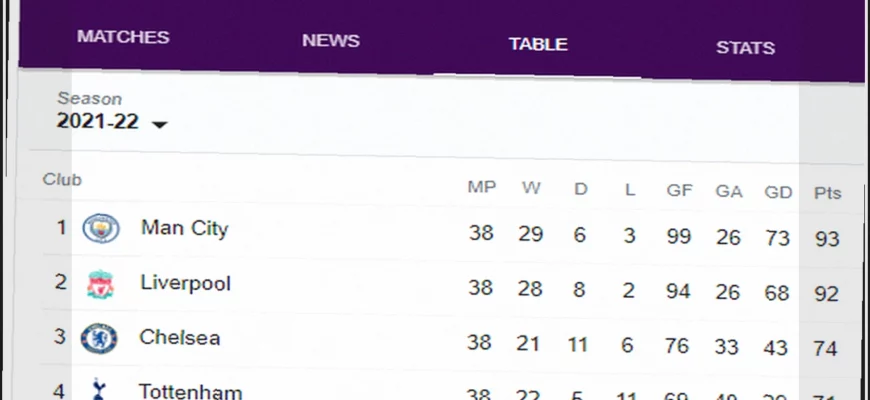
Extending these individual match results across a nine-month season, each club plays 38 games (19 home, 19 away). Points are tallied after every round, causing the league table to frequently fluctuate, particularly early in the season. The EPL standings prioritize total points above all other factors.
It’s crucial to note that the scoreline itself doesn’t alter the points awarded; a narrow 1-0 win holds the same value as a commanding 5-0 victory. This lack of “style points” introduces tension; a team holding a slim lead late in a game understands that conceding a goal means losing two crucial points (dropping from three to one).
As the season unfolds, trends emerge: title challengers typically maintain an average of two or more points per game, while teams at the bottom often struggle to reach one. Fans regularly engage in mental arithmetic, calculating potential table shifts. The Premier League’s point system is effective precisely because of its clarity, directness, and unforgiving nature.
| Match Result | Points Awarded | Seasonal Impact |
| Win | 3 | Rapid climb, especially during streaks |
| Draw | 1 | Slow accumulation, limited separation |
| Loss | 0 | Stagnation while rivals move |
What Happens in Case of Tied Points?
Given the system’s simplicity, teams frequently finish with identical point totals after 38 games. In such instances, tie-breakers are applied sequentially:
- Goal difference (goals scored minus goals conceded)
- Total goals scored
- Head-to-head comparison (if required)
- A playoff in rare and decisive situations (e.g., for the title or relegation)
Goal difference, which assesses a team’s overall balance, is the primary tie-breaker, emphasizing both offensive and defensive performance. If goal differences are equal, total goals scored becomes crucial, explaining why teams might seek additional goals even in comfortably won matches, as an October goal could prove decisive in May. These nuanced rules underscore that while a win always yields three points, the broader league narrative is more intricate. Every single goal can provide crucial insurance against tied points, highlighting how every detail—from a missed opportunity to a conceded equalizer—accumulates throughout the long season. This meticulous accounting contributes to the system’s intense atmosphere, where simple addition ultimately unveils the season’s profound consequences in May.
The Transformative Power of Three Points for a Win
The concept of three points for a win, now standard, was not always the norm. English football historically awarded two points for a victory. This seemingly minor numerical change, from two to three, profoundly transformed the sport’s psychology, arguably more than many tactical shifts. With a win now tripling the value of a draw, the system inherently encourages attacking play. The appeal of simply holding a 0-0 away from home diminishes, as a single goal can double a team’s match earnings. This impacts late-game substitutions, risk appetite, and defensive strategies.
As former FIFA President Sepp Blatter once noted, the three-point system was designed to promote more positive football, an observation that remains valid. The modern Premier League rewards initiative: a draw offers stability, but a win generates crucial momentum. Over 38 matches, this momentum effect is cumulative. Comparing two title hopefuls, one frequently settling for draws in close games and another consistently converting them into narrow wins, can result in a significant points difference of six, eight, or even ten by May. This divergence isn’t necessarily due to one team being vastly superior, but rather its ability to convert more evenly contested matches into victories—a subtle yet potent aspect of the system.
The Real Stakes: What Points Decide
The elegance of the Premier League’s structure lies in its unequivocal nature. At season’s end, the team accumulating the most points is crowned champion, without need for playoffs or additional finals; the league table is the ultimate determinant. Below the champions, top finishers secure qualification for prestigious European competitions, primarily the UEFA Champions League, with further spots potentially leading to the Europa League or Conference League based on domestic cup results. Conversely, at the bottom, the three teams with the fewest points face relegation.
This context transforms the abstract concept of “how points work” into a tangible reality. Points are not merely statistics; they dictate club revenue, international visibility, squad composition, and managerial longevity. A single win in April can guarantee Champions League entry, valued at tens of millions, while one dropped point in May can precipitate relegation and extensive financial reorganization. Fans frequently cite benchmarks like “forty points for safety” or “ninety for the title,” which, though unofficial, represent critical survival calculations derived from historical patterns. This underscores why the value of a win is so significant: those three points have far-reaching, consequential effects.
Consistency, Records, and the Demands of the EPL Points System
The EPL points system has facilitated remarkable point totals over time, most notably Manchester City’s record-setting 100 points in the 2017–18 season, which required an average of over 2.6 points per match, allowing virtually no room for error. Conversely, survival at the bottom of the table has varied, sometimes needing fewer than 35 points, other times over 40, demonstrating that “safety” is context-dependent. Key statistics highlight the system’s rigorous demands:
- The theoretical maximum in a 38-match campaign is 114 points.
- Title winners rarely lose more than five matches in a season.
- Relegated teams often fail to convert draws into victories.
This last point is critical: draws offer slow accumulation, while wins create decisive separation. Managers frequently emphasize “turning one point into three,” recognizing that under this system, small advantages quickly compound. The goal isn’t to dominate every match, but to consistently secure more three-point wins than competitors.
Conclusion
In theory, the Premier League’s point system is strikingly simple: three points for a win, one for a draw, and zero for a loss. Yet, over a nine-month season, this simplicity translates into immense intensity. The system champions boldness, penalizes complacency, and offers little forgiveness for prolonged poor form.
While grasping the mechanics of a Premier League win is easy, experiencing a season defined by these figures is an entirely different matter. The league table, impartial and unwavering, simply tallies the points, ultimately revealing the season’s unvarnished truth in May.
FAQ
How many points is a win in Premier League?
A win gives a team three points, regardless of the scoreline (e.g., 1-0 or 5-2). These three points represent the maximum return from a single league game and are fundamental to both title challenges and survival campaigns.
How do points work in Premier League across the season?
Each club plays 38 matches, and points from every result are added to a running total. The league table is ranked primarily by total points accumulated from August to May. There are no bonus systems or post-season adjustments; the final standings are purely based on this accumulation.
What happens if two teams finish on the same number of points?
If teams are level on points, goal difference (goals scored minus goals conceded) is the first tie-breaker. If that’s also identical, the total number of goals scored becomes the deciding factor. Further rare circumstances might require head-to-head comparisons or even a playoff for critical positions like the title or relegation.
How many points are normally needed to win the league?
While there’s no fixed target, recent seasons suggest that a points total typically in the high 80s or 90s is required to win the Premier League. The exact number depends heavily on the competitiveness and consistency of the leading rivals in a given season.
Is 40 points always enough to stay in the Premier League?
Forty points is a common historical benchmark for Premier League safety, but it’s not a strict guarantee. Some seasons have seen teams survive with fewer points, while others have required slightly more. Survival ultimately depends on the points accumulated by the teams in the relegation zone rather than a fixed universal threshold.