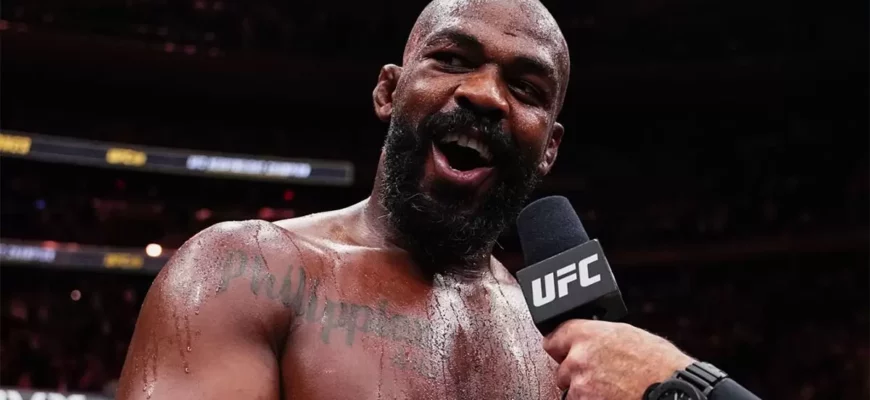
Currently, Jon Jones holds a strong negotiating stance with the UFC, a position envied by many, but this advantage is temporary.
UFC veteran Matt Brown shares this view, acknowledging that fighters typically have limited leverage when negotiating with UFC officials such as Dana White and Hunter Campbell. However, Jones has carved out a situation giving him slightly more command over his path, largely due to the significant interest surrounding a possible bout with Tom Aspinall. Despite this, Brown advises Jones against pushing his demands too far, as the UFC is ultimately prepared to proceed without him.
“The UFC understands that the most significant heavyweight contest possible involves Jon Jones, unequivocally,” Brown stated on The Fighter vs. The Writer podcast. “They are fully aware of this. Yet, we also know the UFC can break records even without his participation. So, I suppose it hinges on how much influence the UFC is willing to grant Jon.”
“They are aiming for the most monumental fight in the heavyweight division`s history, and they recognize that a matchup between Tom and Jon would deliver that now. Simultaneously, they are aware that if Jon simply refuses and departs, they will promote another fighter. They might elevate someone like Ciryl Gane to appear like a formidable threat. This pattern is familiar. The sport progresses. It moves forward. The heavyweight class simply has fewer prominent contenders available.”
Brown suggests that the limited pool of heavyweight contenders, coupled with Jones`s significant drawing power, currently gives him a strong hand, particularly as the UFC is actively negotiating a new broadcast agreement set to start in 2026.
The scenario would be significantly different if, for example, former heavyweight king Francis Ngannou were still with the promotion. However, with him no longer an option, the UFC recognizes that Jones versus Aspinall is arguably the most significant potential fight in mixed martial arts at this time.
“This is precisely where Jon possesses some leverage,” Brown elaborated. “As it`s the heavyweight division, it`s the primary revenue generator. This is where the largest fights are made, and where audience interest is highest. It presents an intriguing balance of power. Negotiations involve this back-and-forth dynamic, and I believe Jon is at a stage in his career where he is actively engaging in this strategic play.”
“He desires greater influence. That`s characteristic of him. Observing his interviews reveals his nature. He seeks that power. He aims to be the dominant figure. He wants the financial rewards. The UFC, as we know their approach, will likely resist these ambitions.”
A factor disadvantageous to Jones is the UFC`s firm control over the MMA market. The organization has consistently achieved record revenues, even while major stars such as Conor McGregor have become inactive.
This doesn`t imply the UFC isn`t interested in capitalizing on a Jones vs. Aspinall bout. However, the patience currently shown amidst delays in arranging the fight has its limits and won`t continue indefinitely.
“The UFC is in a position where its individual fighters` leverage almost becomes insignificant,” Brown commented. “They will generate substantial sales regardless. Their brand is incredibly strong. I question how much fundamental change can occur without major legal intervention. Otherwise, they will just keep moving forward.”
Certainly, Aspinall has openly expressed his frustration about the wait for Jones. However, Brown isn`t convinced that Aspinall is truly prepared to abandon the prospect of that specific fight.
Despite Aspinall`s vocal statements in interviews and on social media, Brown suspects the UFC has likely reassured him that the fight with Jones is inevitable. Otherwise, Brown believes Aspinall would have already sought a different opponent.
“We aren`t privy to the specifics of what`s happening internally,” Brown remarked. “We don`t know the communication from either Jon`s or Aspinall`s camp. I tend to give Aspinall the benefit of the doubt here. If he genuinely didn`t believe the Jon Jones fight was going to materialize, he would likely have accepted a different bout.”
“Comparing this to the situation involving Michael Chandler and Conor McGregor, I felt more strongly about that case because it seemed to me Chandler was waiting for something with diminishing odds of happening, which only lessened further over time. He was holding out for a slim possibility, whereas Aspinall has a valid justification for waiting for Jon. Jon is still actively competing. He still has motivations to fight, and he has essentially stated his financial terms, indicating he`s willing to fight if the compensation is adequate.”
In the end, Brown anticipates that an agreement will be reached. This is because Jones aims to enhance his legacy, and a fight against Aspinall presents an excellent opportunity for him to do so.
In contrast to Conor McGregor, whose fighting future is uncertain, Brown is confident that Jones retains the drive to compete. He sees Aspinall as the most significant and optimal opponent currently available for Jones.
“Jon is fundamentally a fighter,” Brown asserted. “He`s not like Conor – and Conor is a fighter, I`m not disputing that – but Jon is distinct. Jon is an entirely different kind of competitor. He`s intensely driven. He desires actual fights. It`s evident. He wants to compete, and while I believe Conor once possessed that same drive, it seems quite clear he hasn`t had it for some time.”
“Furthermore, there are no other suitable opponents for Jon. If he intends to continue his career, his only viable opponent is Tom, full stop. There are no other alternatives currently. Therefore, I understand why Tom is waiting for him. I truly do, and I suspect that if Tom had other compelling options and wasn`t reasonably sure the fight with Jon would happen, he would have pursued different matchups.”