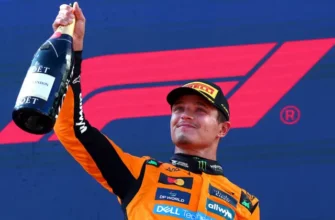
ABU DHABI, UAE – The final miles of a Formula 1 World Championship season are rarely smooth. They are defined by an agonizing blend of technical precision and raw human vulnerability. For Lando Norris, approaching the final three corners of the Abu Dhabi Grand Prix, the cocktail was potent enough to induce involuntary shaking inside the cockpit. He was not just finishing a race; he was concluding an 18-year odyssey that began with a childhood go-kart and culminated in the most coveted prize in motorsport.
As the McLaren driver crossed the line, securing a pivotal third-place finish—more precious than any victory—the torrent of emotion was instantaneous and overwhelming. The audible break in his voice over the team radio, swiftly followed by an unconvincing denial, “I’m not crying,” spoke volumes. This was the moment the pressure, scrutinized globally for months, finally fractured and released.
Norris had done it. Not only had he earned the title, but he had also repaid a monumental debt: the unwavering sacrifice of his family.
The Weight of Worth: A Family’s Triumph
Stepping onto the podium, the bronze trophy in his hands represented the final, tangible proof that every late night, every financial commitment, and every moment of doubt shared by his parents, Cisca and Adam, had been worth it. Norris was quick to deflect the praise, insisting the championship belonged to the collective.
“This is not my world championship,” he declared later that evening. “This is ours. I get to say, ‘Thank you, Mom’ and, ‘Thank you, Dad.’ They’re the ones who sacrificed so much to let me live my dream. I finally get to make them feel like everything they did was worth it.”
The sentiment highlights a characteristic often overlooked in the high-stakes world of F1: the foundation of support required to sustain a champion’s ambition. While the world saw the high-speed thrills, Norris internalized the responsibility to validate that foundational sacrifice.
The Tightrope Walk in the Desert
The title decider itself was less a glorious procession and more a masterclass in controlled, defensive driving under immense psychological strain. Norris only required a podium finish to secure the championship ahead of rival Max Verstappen and teammate Oscar Piastri. Yet, the palpable anxiety surrounding his grid spot—including a worrying omen of a nervous track security guard mere feet from his car—underscored the stress of the weekend.
Crucially, the race was not without its customary flashpoint. Running an alternative strategy, Norris found himself battling the cars of those running longer on older tires, including Yuki Tsunoda, in his final race for the Red Bull affiliate team. Radio chatter from the Red Bull pit wall clearly signaled Tsunoda’s obligation to obstruct Norris and aid Verstappen’s strategy.
As Norris attempted an overtake on the back straight, he briefly ran all four wheels off the track. In a season already saturated with controversial decisions, the investigation into the legality of both drivers` actions initiated an agonizing wait. If the transgression had been deemed illegal, the five-second penalty would have been catastrophic. The stewards, however, placed the blame on Tsunoda’s aggressive defense, issuing him the penalty and allowing Norris to continue his march toward the title. It was a margin measured in centimeters, and as Norris later admitted, the sheer fragility of that moment caused him to stop taking unnecessary risks, avoiding even the slightest curb contact, fearing a mechanical failure that would cost him everything.
The Self-Doubt and the Technical Turnaround
Norris’s title run was remarkable primarily because of the profound internal transformation halfway through the season. By his own candid account, the first half was marred by inconsistency and self-doubt, amplified by the fierce—and, at times, unfortunate—competition with the fast-improving Piastri. A collision with his teammate in Canada left Norris feeling “embarrassed,” while an oil leak resulting in a devastating DNF in the Dutch Grand Prix created a substantial points deficit to Piastri.
The consensus might have been that the pressure was off following the deficit, enabling him to drive with freedom. Norris revealed the opposite was true.
The turnaround required a systematic, technical overhaul of his entire approach, moving beyond the track. He hired more professionals, doubled down on simulator work, and adopted a more advanced analytical approach to data. This was not a sudden burst of confidence; it was a calculated, deliberate refinement of his process.
“I had to dig deep and try and understand more things quicker and in a more advanced way than I ever have before,” Norris explained. “That’s what gave me the advantage I had, not, ‘Oh, the pressure’s off.’ It was really the opposite.”
Winning on His Own Terms
Inevitably, the championship victory sparked the perennial debate: was Norris the *most* worthy champion, especially considering Max Verstappen secured more race wins in a less competitive car? This narrative, however, holds little interest for the newly crowned champion.
Norris maintained that his motivation was never about proving superiority over rivals like Verstappen, whose aggressive, forceful style has defined recent F1 eras. For Norris, the victory was validation of his own method.
He won by remaining true to his own calculated, quick, and mentally resilient self—not by attempting to emulate the aggression that defines other champions. This commitment to authenticity, even when faced with high-stakes moments that demand brute force, is what he holds as his greatest achievement.
His success stands as a powerful refutation of internal skepticism. “There were doubts I had in the beginning of the year, and I proved myself wrong,” he concluded. In Abu Dhabi, Lando Norris did more than just win the Formula 1 World Championship; he answered the fundamental question of whether a driver must fundamentally change who they are to succeed at the highest level of motorsport. By winning his way, the answer was a resounding “No.”