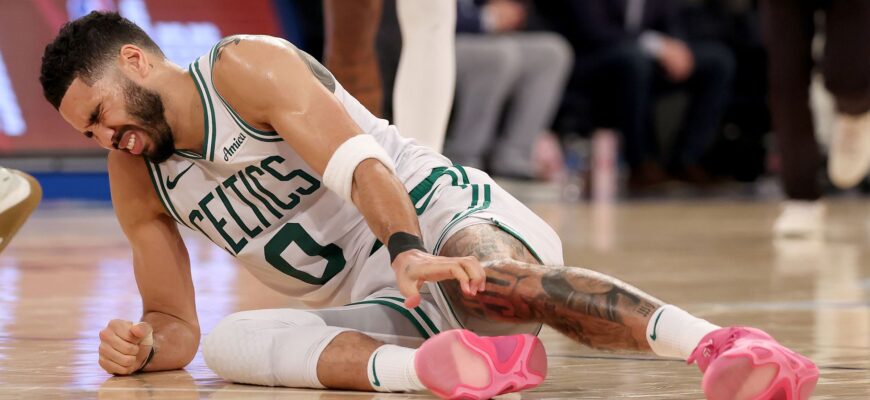
In a span of just two weeks, two prominent NBA players have suffered season-ending Achilles tendon tears, falling to the court in pain.
First, Milwaukee Bucks guard Damian Lillard sustained the injury on April 27 during the first round of the playoffs against the Indiana Pacers. Then, Boston Celtics star forward Jayson Tatum suffered a similar rupture on May 12 in Game 4 of the Eastern Conference semifinals. Tatum showed clear signs of distress, unable to bear weight on his injured right leg as he was assisted off the court and taken via wheelchair to the locker room, likely confirming his immediate fears.
Achilles tendon tears are often unmistakable. The moment of injury is frequently marked by a sudden `pop` sound, which might even make the athlete instinctively look behind them. This is followed by an immediate understanding of the severity. Most athletes realize instantly they cannot walk, and attempting to do so results in an awkward lift of the foot, unable to push off the ground.
Connecting the calf muscles to the heel bone, the Achilles tendon is crucial for movement. It transmits the force generated by calf muscle contractions to allow activities ranging from simple walking to explosive actions like jumping or sprinting. NBA athletes place immense stress on their Achilles tendons through constant running, jumping, cutting, and pivoting. This subjects the tendons to cycles of rapid stretching and powerful contraction, which can result in acute inflammation or, over time, chronic structural damage, making them susceptible to rupture.
Many Achilles ruptures occur similarly to Tatum`s injury mechanism. This often happens when a player steps back into a lunge, stretching the Achilles of the trailing leg, and then attempts to push off forcefully. The tendon fails at this critical point as it rapidly transitions from a stretched position to a powerful contraction.
For elite athletes, surgical repair is the standard treatment for an Achilles tear. While some might have found the timing of Tatum`s surgery, less than 24 hours after the injury, surprisingly quick, it is considered optimal. Research, including a 2020 study in Knee Surgery, Sports Traumatology, Arthroscopy, supports the advantages of prompt repair, showing better outcomes in terms of tissue structure and function when surgery is performed within 48 hours. Although not always possible, the consensus in sports medicine is that avoiding delays is crucial for the best tendon healing.
Following surgery, Tatum will initially wear a cast to protect the repaired tendon. After the cast is removed, he will begin controlled exercises to restore ankle motion. While movement is necessary, protecting the delicate repair from overstretching is vital. The Achilles tendon relies on its elasticity for power; overstretching during recovery can severely impair its function, similar to a rubber band losing its snap.
The rehabilitation process progresses to include light strengthening exercises and a gradual increase in weight bearing, moving from a cast or protective boot to a regular shoe. As the repair heals further, more extensive range-of-motion exercises are introduced, culminating in a return to running, jumping, agility drills, explosive movements, and eventually, basketball-specific activities. For professional athletes, the typical timeline for returning to play is six months to a year, with NBA players often requiring around 10 months, depending on individual healing, fitness progression, and the league schedule.
Beyond the physical challenges, the mental aspect of recovery is significant. An Achilles rupture is a sudden and severely disabling injury that can leave athletes questioning if they will ever regain their previous performance level, particularly early in rehab. Even upon returning to competitive play, it can take time to reach pre-injury performance metrics. Restoring both physical power and confidence in the injured leg often requires consistent gameplay. Many athletes who recover from this injury report feeling their full pre-injury explosiveness doesn`t return until their second season back.
At 27, Tatum benefits from his relative youth and a limited history of major injuries, factors generally favorable for recovery. In addition to the prompt surgery, his procedure was performed by a highly regarded foot and ankle surgeon, Dr. Martin O`Malley at the Hospital for Special Surgery. Dr. O`Malley is part of the Brooklyn Nets` medical staff and has consulted on many NBA cases, including the 2019 Achilles repair for Kevin Durant. Durant`s successful return to elite play following his own Achilles tear offers a positive example for Tatum as he navigates the demanding rehabilitation journey.
Considering this, here are some notable NBA players who have returned from Achilles tears, serving as potential comparisons for Tatum`s recovery path.
Kobe Bryant: One of the most iconic NBA players to experience this injury, Bryant was 34 when he tore his Achilles just before the 2013 playoffs. He had surgery in April and remarkably returned in December of the same year. While his return was quick, he visibly lacked his previous explosiveness. Unfortunately, his next two seasons were cut short by other injuries, and he retired after the second one.
Klay Thompson: Thompson`s case is distinct because his right Achilles tear occurred while he was already rehabilitating a torn ACL from the 2019 NBA Finals, which caused him to miss the 2019-20 season. As he neared a return for the 2020-21 season, he suffered the Achilles injury. He eventually returned mid-season in 2021-22 at age 31, playing fewer minutes and showing reduced shooting efficiency initially. However, he had a strong comeback the following season, increasing his minutes and achieving career highs in three-pointers and rebounds.
Kevin Durant: Durant tore his right Achilles during the 2019 NBA Finals while playing for the Golden State Warriors. Significantly, he signed a four-year contract with the Brooklyn Nets during his recovery period, indicating league confidence in his comeback potential. He missed the entire 2019-20 season but returned impressively the next year. Although limited to 35 games due to various injuries, he played at his characteristic elite level. The longer recovery time (around 18 months) might have contributed to his strong performance upon returning. Durant`s successful return, even after turning 30, demonstrates that it is possible for NBA stars to regain pre-injury form after an Achilles rupture.