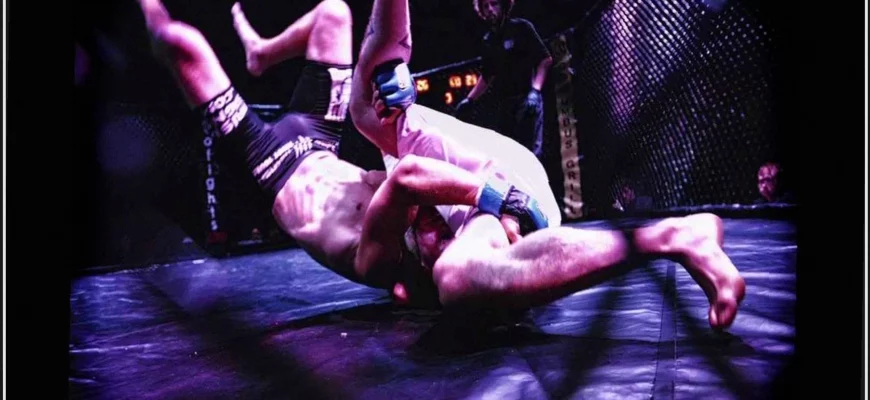
The concern that MMA might eventually succumb to the same spectacle-driven, “freak-show” matchmaking that boxing has recently embraced is already a reality. This shift isn’t happening uniformly or instantaneously, but it is underway.
Boxing has shed its pretense of avoiding such events. For instance, Jake Paul’s December 2025 bout against Anthony Joshua, a crossover mismatch that would have seemed satirical just a few years ago, drew an impressive 33 million global viewers on Netflix. Furthermore, Oleksandr Usyk is slated to defend his WBC heavyweight title against kickboxing star Rico Verhoeven in May at the Pyramids of Giza, a booking that modern boxing now considers premium rather than something to be embarrassed about.
However, MMA has never been as pristine as some might recall. The early days of the UFC were characterized by a chaotic, style-vs-style environment with minimal rules, limited weight classes, and a “freak-show” energy that the polished modern product claims to have outgrown. The Fedor Emelianenko vs. Hong Man Choi fight serves as a prime example of the entertaining spectacle from that era. Therefore, this trend isn’t an external corruption but rather a part of MMA’s historical fabric.
The Business Model is Changing
What has changed is the surrounding business climate. Previously, this inclination was largely confined to the fringes, appearing in PRIDE oddities, Bellator’s nostalgic matchups, or rare hybrid-rules experiments. Now, the incentives are greater, the platforms are broader, and the available talent for such bookings holds significantly more commercial appeal. A prominent example is Ronda Rousey’s upcoming return to MMA in May to face Gina Carano, headlining Netflix’s inaugural live MMA broadcast for Jake Paul’s Most Valuable Promotions. By March, the card also featured Francis Ngannou vs. Philipe Lins and Nate Diaz’s return to MMA. This indicates an industry actively cultivating spectacle rather than avoiding it.
Stripping away the promotional language reveals a clear logic. A promoter’s primary objective is not to safeguard the sport’s integrity but often the opposite: to maximize revenue. In this context, combat sports matchmaking can resemble playing online casino slots, hoping for the right combination of symbols to hit the jackpot. Rousey, Carano, Netflix, Ngannou, Diaz, Perry – by placing enough recognizable figures on the “reels,” the expectation is that the “lights will flash,” leading to financial success. The focus shifts from the purest sporting contest to the combination most likely to yield profit. Boxing has openly embraced this philosophy, and MMA is increasingly adopting a similar “casino mentality,” particularly outside the UFC.
The UFC Still Has Reasons to Resist
This doesn’t necessarily mean the entire sport is doomed to become a traveling circus. The UFC’s success has historically relied on promoting legitimacy, rankings, title stakes, and the importance of competitive progression. While Dana White may criticize boxing promoters as “rinky-dink,” his very criticism highlights the UFC’s strategic positioning as a more organized and coherent alternative to a boxing market that readily jumps from one bizarre payday to the next. A promotion built on sporting order is unlikely to transform the Octagon into a permanent venue for novelty acts, not due to moral superiority, but because its brand is founded on a different form of control.
The challenge is that MMA is not solely defined by the UFC. This is where the “destined” aspect of the question becomes crucial. One Championship has already experimented with mixed-rules bouts, such as Demetrious Johnson vs. Rodtang, which many viewed as a return to the sport’s origins rather than a new gimmick. KSW embraced pure spectacle when Eddie Hall defeated Mariusz Pudzianowski in 30 seconds last year, and the demand for such absurdity was strong enough for Hall to immediately express interest in fighting “the freaks of the world” rather than pursuing legitimate rankings. The market clearly supports this kind of entertainment.
Fans Are Part of the Problem Too
Therefore, the pertinent question isn’t whether MMA will feature “freak-show” fights – it always will. The real issue is who will control the proportion of the fight calendar they occupy. If the UFC maintains its discipline, it can likely keep the mainstream upper echelon of the sport focused on athletic competition rather than stunts. However, if blockbuster cards like those on Netflix achieve significant viewership, if Jake Paul’s promotional strategies continue to influence MMA, and if rival promotions realize they can gain attention more rapidly through celebrity matchups than by developing contenders, the sport’s periphery will inevitably become more peculiar, louder, and more akin to boxing.
This evolution might not be entirely negative. Combat sports have always had an element of the side-show. Fans are not entirely blameless; they may decry “freak-show” fights publicly, only to become engrossed when promotional trailers are released, sparking debates about an aging legend’s capabilities, an underdog’s punching power, a giant’s endurance, or a boxer’s ability to counter a takedown. This is all tied to the perennial “what if?” question, which sells almost as reliably as a title fight and thus continues to drive such matchups.
The Jackpot is Obvious
In conclusion, while we don’t believe MMA is destined to fully transform into boxing, significant portions of it are certainly set to adopt boxing’s current playbook. The financial incentives are too substantial, the platforms are too eager, and the available talent is too marketable. The only remaining debate concerns the extent to which the sport will be drawn into this orbit and how quickly. Boxing has already demonstrated the consequences when promoters prioritize the “jackpot” over the purity of the lineup. MMA may not be entirely there yet, but it is close enough to hear the metaphorical slot machine reels spinning.