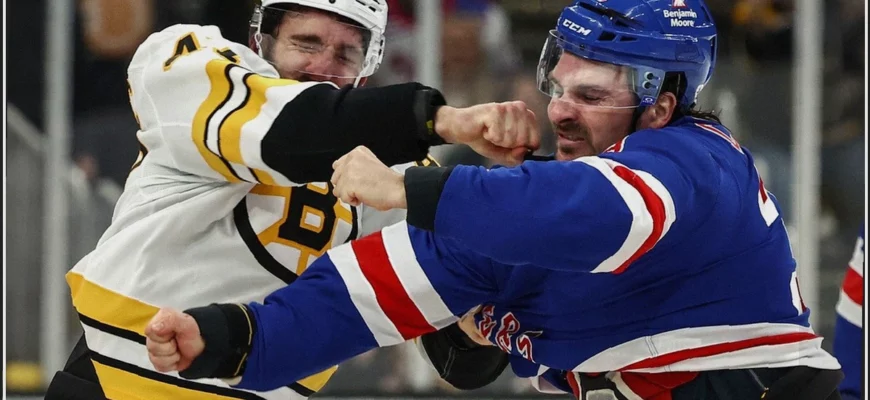
The role of fighting in the NHL has transformed significantly over recent decades. Once a defining characteristic of the sport, dropping the gloves is no longer an everyday expectation. The contemporary game prioritizes speed, skill, and structure, leaving minimal space for the traditional enforcer.
Nevertheless, fighting has not vanished entirely; it has merely changed. While its frequency has plummeted to historic lows, certain teams and players continue to employ it in specific circumstances. The pertinent question is no longer whether fighting exists, but rather what purpose it serves in today’s NHL.
- From Staple to Situational Tool
- Why Fighting Still Exists
- A New Generation of Players
- A Divided Perspective
- Fighting’s Limited Impact on Outcomes
- Evolution, Not Extinction
- Why Fighting Still Exists
- A New Generation of Players
- A Divided Perspective
- Fighting’s Limited Impact on Outcomes
- Evolution, Not Extinction
From Staple to Situational Tool
Fighting experienced a surge following the NHL’s 1967 expansion, reaching its zenith in the 1980s. During the 1987–88 season, the league averaged approximately 1.10 fights per game. Teams cultivated identities built on physical intimidation, and enforcers occupied distinct roster spots.
Players like Bob Probert and Tie Domi became widely recognized for their toughness rather than their scoring prowess. Their role was unambiguous: protect teammates, retaliate against cheap shots, and alter game momentum.
League regulations and structural shifts gradually diminished that role. The instigator penalty, introduced in the early 1990s, imposed consequences for initiating fights, often placing teams at a disadvantage. The introduction of the salary cap in 2005 further reshaped roster construction, making it unsustainable for teams to justify carrying one-dimensional fighters.
Concurrently, rule adjustments accelerated. The removal of the two-line pass and restrictions on obstruction opened up the ice. Teams began prioritizing skating and puck movement, leading to the phasing out of players who couldn’t keep pace.
By the late 2010s, the rate of fights per game fell below 0.20. Recent seasons have hovered in the low 0.20 range, a mere fraction of the league’s previous eras.
Why Fighting Still Exists
Despite its decline, some teams still engage in fighting more than others. In the 2025–26 season, the Tampa Bay Lightning recorded 44 fights, the highest in the league. The Boston Bruins followed with 33, and the Anaheim Ducks had 26. The league average stood at approximately 0.23 fights per game.
At the player level, Boston’s Mark Kastelic and Vancouver’s Curtis Douglas led the NHL with 10 fights each. However, the majority of players did not fight at all.
The disparity between teams reflects differences in philosophy and roster construction. Some organizations still value physical pushback, while others are built entirely around speed and skill.
Today, fighting primarily serves two functions. Firstly, it acts as an immediate response to a questionable hit, particularly when star players are involved. Secondly, it can be used to attempt to spark momentum when a team is playing lethargically.
What has largely disappeared are contrived fights. It is now rare to witness players dropping the gloves from a neutral-zone faceoff without any discernible context. Modern fights are typically linked to specific in-game moments rather than premeditated displays.
A New Generation of Players
The reduction in fighting also mirrors how players are currently developed. Younger players progress through systems that emphasize skating, puck control, and positional play. Fighting is not a focus and is often actively discouraged in many leagues.
In NCAA hockey, fighting results in immediate ejection and potential suspension. European leagues also impose strict penalties. Consequently, players reaching the NHL often have limited experience with fighting and no incentive to integrate it into their game.
Physicality persists, but it manifests differently. Board battles, net-front positioning, and forechecking pressure have supplanted open-ice intimidation. Players utilize strength and leverage, rather than fists, to gain an advantage.
This shift aligns with broader concerns regarding player safety. Heightened awareness of head injuries and long-term health risks has influenced how teams and leagues approach physical play.
A Divided Perspective
Fighting remains one of hockey’s most contentious topics, with opinions varying widely among fans, players, and analysts.
A 2026 survey conducted in Canada revealed that 57 percent of respondents favored banning fighting in professional hockey. Among self-identified core fans, the division was nearly even, with 49 percent supporting a ban and 47 percent opposing it.
Support for eliminating headshots was significantly higher, suggesting that many fans differentiate between dangerous hits and controlled fights. For some, fighting still represents accountability within the game; for others, it is an unnecessary risk.
This division reflects the sport’s broader evolution, as hockey continues to balance tradition with contemporary priorities, including safety and skill development.
Fighting’s Limited Impact on Outcomes
From a performance perspective, fighting has a minimal impact on a team’s ability to win. Data indicates that teams do not consistently gain an advantage from fighting over the course of a season.
Short-term momentum shifts can occur. A fight might energize a bench or a crowd, but these effects are transient. Game outcomes continue to be primarily determined by puck possession, special teams performance, and goaltending.
Fighting can still influence isolated moments. Instigator penalties or additional minor penalties can create power-play opportunities. Losing a player due to misconduct or injury can shorten a team’s bench. While these factors are significant in-game, they rarely shape long-term results.
Teams that engage in more fighting may also adopt a more aggressive style of play, which can lead to higher penalty totals. However, this correlation does not translate into a reliable edge in overall performance.
Evolution, Not Extinction
Fighting in the NHL is no longer central to the sport’s identity. The era of the dedicated enforcer has concluded, and the statistics clearly demonstrate a steep decline.
However, fighting has not disappeared. It continues to be a part of the game, albeit in a reduced and more strategic form. Teams employ it selectively, often tied to specific situations rather than as a consistent tactic.
The NHL continues its evolution towards speed and skill, yet physicality still plays a role. Fighting now exists on the periphery, not at the forefront.
For today’s game, this balance defines the reality. Fighting is no longer the heartbeat of hockey, but it has not been eradicated; it has simply adapted.
Why Fighting Still Exists
Despite the decline, some teams still fight more than others. In the 2025–26 season, the Tampa Bay Lightning recorded 44 fights, the most in the league. The Boston Bruins followed with 33, while the Anaheim Ducks had 26. The league average sat at approximately 0.23 fights per game.
At the player level, Boston’s Mark Kastelic and Vancouver’s Curtis Douglas led the NHL with 10 fights each. Most players, however, did not fight at all.
The gap between teams reflects differences in philosophy and roster construction. Some organizations still value physical pushback. Others build entirely around speed and skill.
Fighting today typically serves two purposes. First, it acts as an immediate response to a questionable hit, especially involving star players. Second, it can attempt to spark momentum when a team is flat.
What has largely disappeared are staged fights. It is rare to see players drop the gloves off a neutral-zone faceoff without context. Modern fights are tied to specific in-game moments rather than premeditated displays.
A New Generation of Players
The decline in fighting also reflects how players are developed. Younger players come through systems that prioritize skating, puck control, and positional play. Fighting is not emphasized and, in many leagues, actively discouraged.
In NCAA hockey, fighting results in an immediate ejection and potential suspension. European leagues impose strict penalties as well. As a result, players reaching the NHL often have little experience with fighting and no incentive to incorporate it into their game.
Physicality still exists, but it looks different. Board battles, net-front positioning, and forechecking pressure have replaced open-ice intimidation. Players use strength and leverage rather than fists to gain an edge.
This shift aligns with broader concerns about player safety. Increased awareness of head injuries and long-term health risks has influenced how teams and leagues approach physical play.
A Divided Perspective
Fighting remains one of hockey’s most debated topics. Opinions vary widely among fans, players, and analysts.
A 2026 survey in Canada found that 57 percent of respondents support banning fighting in professional hockey. Among self-identified core fans, the split was nearly even, with 49 percent in favor of a ban and 47 percent opposed.
Support for eliminating headshots was significantly higher, suggesting that many fans distinguish between dangerous hits and controlled fights. For some, fighting still represents accountability within the game. For others, it is an unnecessary risk.
This divide reflects the sport’s broader evolution. Hockey continues to balance tradition with modern priorities, including safety and skill development.
Fighting’s Limited Impact on Outcomes
From a performance standpoint, fighting has minimal impact on winning. Data shows that teams do not consistently gain an advantage from fights over the course of a season.
Short-term momentum shifts can occur. A fight may energize a bench or crowd, but those effects are brief. Game outcomes continue to depend on puck possession, special teams, and goaltending.
Fighting can still influence isolated moments. Instigator penalties or additional minors can create power-play opportunities. Losing a player to misconduct or injury can shorten a bench. These factors matter in-game but rarely shape long-term results.
Teams that fight more often may also play a more aggressive style, which can lead to higher penalty totals. However, that correlation does not translate into a reliable edge in overall performance.
Evolution, Not Extinction
Fighting in the NHL is no longer central to the sport’s identity. The era of the dedicated enforcer has ended, and the numbers reflect a steep decline.
However, fighting has not disappeared. It remains part of the game, in a reduced, more strategic form. Teams use it selectively, often tied to specific situations rather than as a consistent tactic.
The NHL continues to evolve toward speed and skill, but physicality still plays a role. Fighting now exists on the margins, not the forefront.
For today’s game, that balance defines the reality. Fighting is no longer the heartbeat of hockey, but it has not been erased. It has simply adapted.