
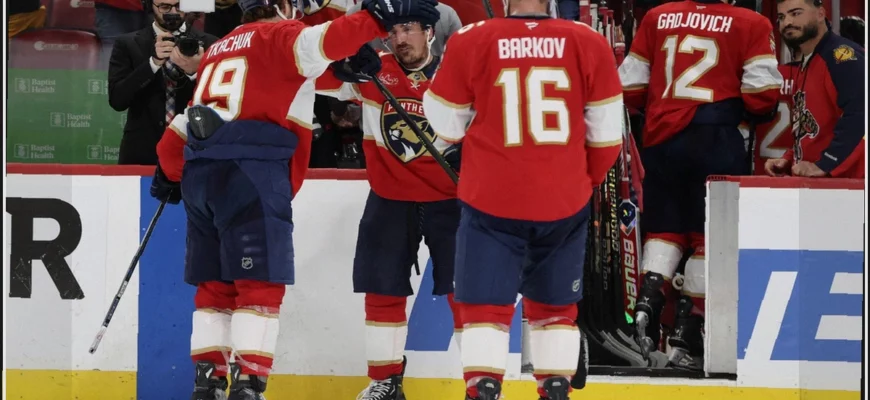
The Florida Panthers, fresh off two consecutive Stanley Cup championships, endured an exceptionally challenging season. Their difficulties began early, with captain Aleksander Barkov sidelined by a season-ending injury during training camp and Matthew Tkachuk recovering from offseason surgery, putting the team at a significant disadvantage from the start.
Throughout the season, the Panthers were plagued by a relentless string of injuries. Key players like Tomas Nosek, Dmitry Kulikov, and Seth Jones missed substantial time due to various ailments, including a shoulder injury for Kulikov and a fractured collarbone for Jones. The cumulative effect of these absences resulted in an astonishing 395 regular-season man-games lost to injury, a figure that only continued to grow. As the team fell out of playoff contention, another injured player was ultimately shut down for the remainder of the season, with surgery anticipated. Other notable players such as Jonah Gadjovich, Cole Schwindt, Sam Reinhart, Uvis Balinskis, and Sam Bennett also spent time recovering. It’s clear that three consecutive deep playoff runs into June exacted a heavy physical toll on the roster.
For many observers, missing the playoffs was viewed as a silver lining for the Panthers. This break allowed for much-needed rest and recovery for the upcoming season, rather than pushing for an improbable three-peat—a feat historically difficult to achieve, requiring every aspect of a team’s performance to align perfectly. Furthermore, the discovery that the first-round pick sent to the Chicago Blackhawks (as part of the Seth Jones trade) was top-10 protected opened the door to potentially retaining a valuable asset for the offseason.
Despite their recent struggles, it would be premature to write off the Florida Panthers, a sentiment echoed by hockey analyst Elliotte Friedman. Discussing the team’s future, Friedman highlighted the Panthers’ impressive track record of reaching three consecutive Stanley Cup Finals, acknowledging that such sustained success inevitably brings wear and tear. While there’s no question about the players’ ability or will, the cumulative physical burden ultimately caught up with them. Friedman specifically noted goaltender Sergei Bobrovsky, a player of Hall of Fame caliber, who experienced a difficult season. This dip in performance, he suggested, is likely attributable to fatigue, emphasizing Bobrovsky’s need for a restorative summer.
Friedman concluded by stressing that underestimating the Panthers would be a mistake, particularly given their reputation as an attractive destination for players. He also pointed out the strategic advantage of securing a high draft pick by finishing in the bottom ten during a challenging year.
Sergei Bobrovsky’s outstanding play was a crucial factor in the Panthers’ three straight appearances in the Stanley Cup Final. Despite past speculation, Bobrovsky has expressed a strong desire to remain in Florida and finish his career with the team. With the majority of their core roster already secured through the 2030 season, the Panthers are expected to pursue a two-to-three-year extension for Bobrovsky, likely within the $6 million to $7.5 million annual range. General Manager Bill Zito may also consider acquiring a goaltender to serve as Bobrovsky’s backup and eventual successor.
The return of a healthy Aleksander Barkov would significantly bolster the Panthers’ defensive capabilities, making them a formidable opponent once again. The Tampa Bay Lightning offer a relevant parallel; after their own deep playoff runs, longer offseasons allowed them to regroup and return even stronger, now poised for another deep playoff push. Similarly, rest and recovery will greatly benefit the Florida Panthers. Therefore, it would be no surprise to see them emerge as strong contenders for the Stanley Cup in the upcoming season.