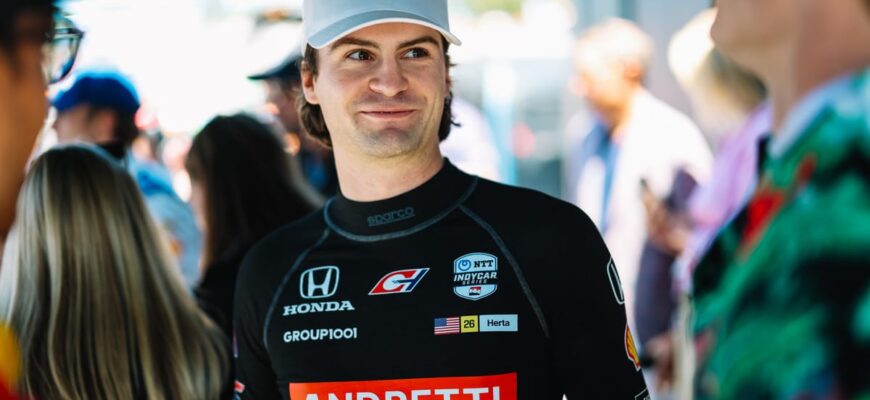
In major league sports, athletes rarely choose a lateral, much less a deliberate step backward, to advance their careers. Yet, this is precisely the unconventional path taken by one of North America`s premier open-wheel talents, Colton Herta. At 25, a seasoned veteran with nine victories and a 2024 IndyCar championship runner-up title, Herta has left the comfort and prestige of the IndyCar Series to compete in Formula 2 (F2)—a feeder category traditionally reserved for young drivers aiming for Formula 1.
The move is akin to a reigning NFL MVP abruptly deciding to return to college football, not out of necessity, but as a strategic maneuver to qualify for a hypothetical, more globally celebrated league. Herta’s gamble is not merely personal; it is a high-stakes litmus test for the global reputation of the entire IndyCar Series.
The Super License Hurdle and the Cadillac Promise
Herta’s driving ability has long been considered Formula 1 worthy. However, the modern Grand Prix landscape imposes strict bureaucratic requirements, namely the Super License points system. Despite Herta`s extensive success in IndyCar, a shortage of these crucial points has previously barred his direct entry into F1.
To overcome this regulatory hurdle, Herta, in partnership with TWG Motorsports—the parent company of the aspiring Cadillac F1 team, controlled by Los Angeles Lakers owner Mark Walters—crafted an audacious plan. By spending a season in F2 with the Hitech TGR team in 2026, Herta aims to amass the necessary license points to secure his future seat with Cadillac F1.
As the legendary Mario Andretti observed, Herta is demonstrating an extraordinary commitment: “That’s how important it is to him. And that is a beautiful commitment I would support 3,000 percent, to go one step down to go two steps forward.”
The Technical Chasm: Firestone vs. Pirelli
While the transition might seem like a sure thing—a professional dominating a developmental league—the technical realities of F2 present a massive challenge. Herta is accustomed to the aggressive, high-downforce, and relatively forgiving Firestone tires used in IndyCar, which encourage hard, continuous driving.
F2, conversely, uses notoriously delicate Pirelli rubber, forcing a fundamentally different approach. The difference is stark, requiring a mastery of patience and precision over sheer speed.
Max Esterson, an American driver who recently transitioned out of F2, illuminated the bizarre reality of European feeder series racing:
- **Limited Useful Laps:** The F2 format severely restricts hard running. Drivers must execute heavily structured, deliberately slow out-laps and warm-up laps to protect the tire surface.
- **Delicacy is Key:** Aggressive inputs penalize the driver immediately by destroying the tire’s integrity.
- **The Qualifying Paradox:** The qualifying session epitomizes this challenge. Drivers must “troll around” for several minutes, then execute a perfect, single hot lap upon arriving at the first corner at high speed. The tire is only optimal for this one chance.
As Esterson dryly noted, “Credit is due to whoever does well, because it’s a different skill set than old-school racing. It’s perfection with very little preparation.”
Herta’s initial taste of this reality came during his three-day F2 test in Abu Dhabi, where he posted times ranking 14th and 19th among the 22 participants. This indicates that while the talent is undeniable, the adaptation process is steep and immediate success is not guaranteed.
The Burden of IndyCar`s Reputation
Colton Herta is carrying more than just his personal ambition on his shoulders; he is carrying the collective credibility of American open-wheel racing. For decades, a narrative has persisted among some European enthusiasts that the skills required in IndyCar (especially on ovals) do not translate effectively to the technical, high-downforce road courses that define Formula 1 and F2.
Pato O`Ward, Herta`s former Andretti teammate and a current McLaren F1 test driver, understands the geopolitical stakes involved. O’Ward is rooting for Herta, not just as a friend, but for the sake of the series they both call home.
“If it doesn`t go well, there’s always going to be those guys that hook to that and use that as rage bait. So that’s the reality. Colton doing well would be a win for IndyCar.”
If Herta, a known generational talent from IndyCar, struggles to adapt to F2, it will inevitably fuel criticism that IndyCar is a technically inferior series whose drivers lack the essential skills for modern F1. Conversely, if Herta dominates the F2 field, it will decisively prove that IndyCar is a breeding ground for world-class talent, effectively elevating its global standing.
Herta`s journey is a rare instance where a driver risks a stellar current career for the sheer potential of a distant dream. His performance in 2026 will be watched intently by both the F1 hopefuls he races against and the IndyCar faithful he left behind, as he attempts to define whether his backwards step truly leads to a forward leap.