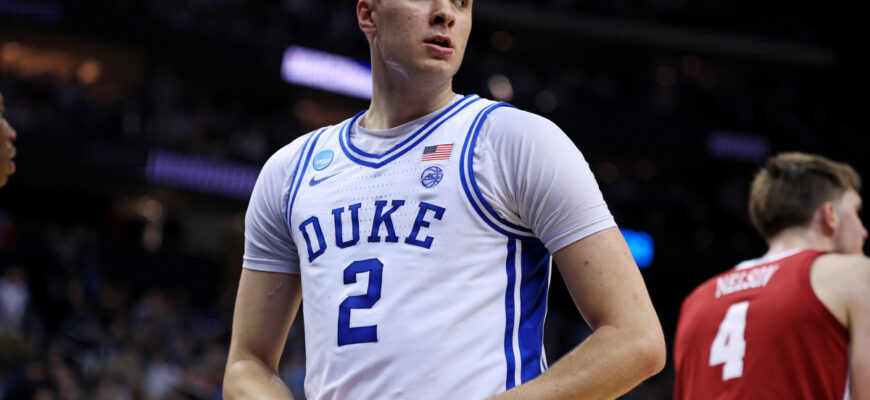
The NBA journey for Cooper Flagg has officially commenced. As widely anticipated, the highly-touted rookie forward from Duke was selected first overall by the Dallas Mavericks on Wednesday night. Many basketball analysts consider him one of the most promising prospects to emerge in the last two decades.
Given this background, what level of production can we realistically expect from him during his debut season?
This analysis will cover how Flagg integrates into the Mavericks` current roster, explore historical comparisons with players possessing similar skill sets, and provide guidance on where to target Cooper Flagg in fantasy basketball drafts this upcoming fall.
How Flagg Fits with the Mavericks
The Dallas Mavericks offer a significantly greater opportunity for a rookie forward than one might typically find on a team with a history of success. With Luka Doncic having been traded and Kyrie Irving sidelined by a torn ACL, the Mavericks possess a roster featuring quality big men (like Anthony Davis, Dereck Lively II, Daniel Gafford, P.J. Washington) and skilled shooters (such as Klay Thompson, Spencer Dinwiddie, Max Christie), but they notably lack offensive initiators and scoring threats from the wing positions.
Consequently, Flagg could be relied upon as a central figure in the Mavericks` offensive strategy right from the start. He should have the chance to earn substantial playing time and handle the ball frequently from day one. Combine this opportunity with Flagg`s considerable talent – which an ESPN analyst suggested would have allowed him to be productive in the league even at age 16 – and Flagg is well-positioned to deliver impactful numbers immediately.
We will gain further insights into Flagg as the summer unfolds, particularly concerning the final composition of the Mavericks` roster after the free agency period. It is also highly probable that we will witness Flagg`s initial professional games during the NBA Summer League in Las Vegas.
All this forthcoming information will be crucial in shaping our official projections for Flagg`s rookie campaign, which are set to be released in a few months.
However, based on what Flagg demonstrated during his time at Duke, we already have a solid foundation for anticipating his performance. These early expectations align with those of a player capable of making an immediate impact in fantasy basketball leagues.
Comparisons to Other Duke Standouts
Similarities to Grant Hill
Like Grant Hill, Flagg enters the NBA as a tall wing player possessing excellent physical attributes and a versatile skill set enabling him to contribute effectively across the board in both offensive and defensive facets of the game. Hill was a more seasoned prospect upon entering the league, having played four years at Duke and beginning his NBA career at age 22. However, Flagg`s statistics from his freshman season at Duke were quite comparable to Hill`s senior year performance. This suggests that despite being considerably younger at 18, Flagg appears similarly prepared for the transition to the NBA level of play.
Similarities to Jayson Tatum
Jayson Tatum is another notable large wing player with the physical build of a combo forward but the playing style of a perimeter-oriented athlete. Tatum is recognized more as a scorer and less as a natural playmaker compared to Hill. In many respects, Flagg`s playing style occupies a middle ground between these two esteemed Duke alumni. While perhaps not possessing the innate point-forward instincts of Hill, Flagg is a superior creator and passer than Tatum was upon entering the NBA. Conversely, while Flagg will need to develop his shooting to reach the level Tatum has achieved, Flagg demonstrates better shooting proficiency coming out of Duke than either Hill or Tatum did at that stage.
Here is a comparison of each of these players` final season statistics at Duke:
| Player | PPG | RPG | APG | SPG | BPG | 3P | FG% | FT% | 3P% |
|---|---|---|---|---|---|---|---|---|---|
| Hill | 17.4 | 6.9 | 5.2 | 1.9 | 1.2 | 1.1 | 46.0 | 69.4 | 37.9 |
| Tatum | 16.8 | 7.3 | 2.1 | 1.3 | 1.1 | 1.4 | 45.2 | 85.4 | 35.0 |
| Flagg | 19.2 | 7.5 | 4.2 | 1.4 | 1.4 | 1.4 | 48.5 | 82.8 | 38.9 |
And this chart presents projected rookie season statistics for Flagg, alongside the actual rookie numbers for Tatum and Hill, showing a college-to-pro transition similar to his predecessors:
| Player | PPG | RPG | APG | SPG | BPG | 3P | FG% | FT% | 3P% |
|---|---|---|---|---|---|---|---|---|---|
| Hill | 19.9 | 6.4 | 5.0 | 1.8 | 0.9 | 0.1 | 48.0 | 72.6 | 25.0 |
| Tatum | 13.9 | 5.0 | 1.6 | 1.0 | 0.7 | 1.3 | 48.1 | 84.4 | 43.3 |
| Flagg | 19.0 | 6.0 | 3.8 | 1.2 | 1.0 | 1.3 | 51.1 | 84.0 | 36.4 |
Where Cooper Flagg Should Be Drafted in Fantasy Basketball
Flagg`s projected total for 3-pointers shown above was slightly adjusted, as it is improbable in today`s NBA landscape that his volume of attempts from beyond the arc would decrease upon joining the league. It`s possible this projection for his 3-point rate is still conservative, but overall, these figures serve well to illustrate the type of production that can be anticipated from Flagg during his rookie year.
These projections indicate that Flagg is positioned to be a top-40 fantasy option as a rookie.
In fantasy points leagues, these average statistics would place Flagg around the 28th spot. For players eligible at the small forward position, this ranking would position him between established players like Jaylen Brown and Franz Wagner.
In fantasy category leagues, Flagg`s projected blend of comprehensive statistical contributions, coupled with favorable shooting percentages and relatively low turnover numbers, is strong enough to place him within the top 25 overall. Among small forwards, he would be slotted between Kevin Durant (ranked 16th) and Jalen Williams (ranked 30th) based on this analysis.
This analysis strongly suggests that Cooper Flagg should be selected within the initial four rounds of fantasy basketball drafts this season.